
For a decade, solar energy was seen as a “green” luxury—a badge of corporate social responsibility. But as we navigate 2026, the narrative has fundamentally shifted. High grid tariffs, fluctuating fuel prices, and the push for energy independence have transformed Solar Panel Installation for Business from a sustainable choice into a core financial necessity.
At Xnergs, we’ve seen the evolution of the industry firsthand. Today’s commercial solar landscape isn’t just about mounting panels on a roof; it’s about engineering high-yield assets that safeguard your bottom line for the next 25 years. This guide breaks down the technical, financial, and strategic roadmap for businesses going solar this year.
1. Why 2026 is the "Golden Year" for Commercial Solar
If you’ve been waiting for solar technology to “mature,” that time has arrived. Several factors have converged in 2026 to make solar adoption more lucrative than ever:
- Grid Tariff Hikes: Commercial and Industrial (C&I) electricity rates in many regions have climbed toward ₹10–₹14 per unit. Solar energy, levelized over its lifespan, effectively costs between ₹2.5–₹3.5 per unit.
- Technological Maturity: We have moved beyond standard polycrystalline panels. 2026 is the year of N-Type TopCon and Bifacial modules, which offer efficiencies crossing 22-25% and better performance in low-light or high-heat conditions.
- Energy Storage Synergy: Battery storage costs have dropped significantly. Businesses are now pairing solar with storage to manage “peak loads” and avoid high-demand charges from the grid.
2. The Financial Blueprint: ROI, Tax Shields, and Payback
A well-designed commercial solar system is one of the few business investments with a guaranteed internal rate of return (IRR) of 18% to 22%.
Accelerated Depreciation (AD)
Under Section 32 of the Income Tax Act, businesses can claim 40% accelerated depreciation in the first year of installation. This acts as a massive tax shield, effectively reducing your initial project cost by nearly 10–12% through immediate tax savings.
The Payback Period
With current incentives and high-efficiency modules, most commercial solar installations reach their break-even point within 3 to 4 years. Considering the panels are warrantied for 25 years, you are essentially looking at 21 years of nearly free electricity.
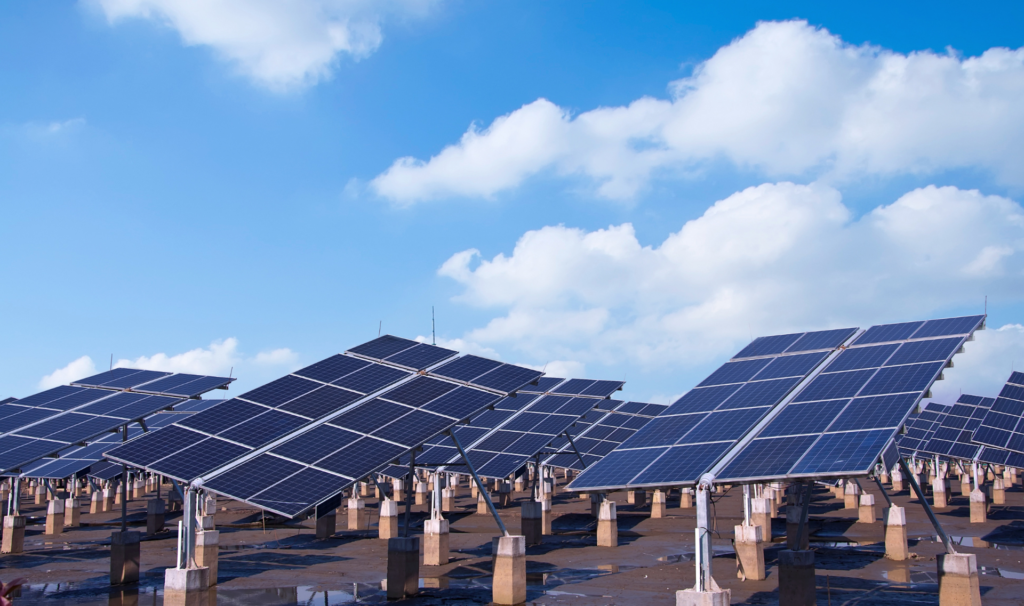
3. Choosing the Right System: Rooftop vs. Ground Mounted
Your business’s infrastructure dictates your solar architecture.
Feature | Rooftop Solar | Ground-Mounted Solar |
Space Utilization | Uses dead space (roof). | Requires 4–5 acres per MW. |
Installation Cost | Generally lower (no land cost). | Higher civil work & structure cost. |
Maintenance | Higher (access/cleaning). | Easier access for automated cleaning. |
Best For | Retail, IT Parks, Small Factories. | Heavy Industries, Cold Storages, Schools. |
4. The "Xnergs" Implementation Process
Going solar shouldn’t disrupt your operations. At Xnergs, we follow a rigorous 5-step deployment protocol:
- 3D Shadow Analysis: We use advanced aerial mapping to ensure no nearby chimneys, trees, or structures cast shadows on your panels at any time of day.
- Structural Integrity Audit: Before a single bolt is tightened, our engineers assess if your roof can handle the dead weight and wind load of the array.
- Procurement of Tier-1 Hardware: We only use high-yield modules and smart inverters equipped with IoT monitoring.
- Net Metering & Approvals: We handle the complex “red tape”—from DISCOM feasibility reports to the final installation of bi-directional meters.
- Real-Time Monitoring: Your facility manager gets a dashboard to track energy generation and savings in real-time, right from a smartphone.
5. Editorial Policy & Reliability Standards
At Xnergs, we believe that energy education is the first step toward energy independence. Our content standards include:
- Verified Data: All cost and ROI calculations are based on 2026 market benchmarks and current government mandates (like the PM Surya Ghar guidelines).
- Expert Authoring: Our guides are written by engineers and consultants with over a decade of field experience—not by generic content generators.
- Zero-Fluff Policy: We focus on actionable business intelligence, avoiding empty buzzwords.
- AEO Compliance: Our content is structured to provide direct, authoritative answers to the most common queries searched by business owners and procurement officers.
Top 5 Frequently Asked Questions (FAQs)
1. Will solar panels damage my factory roof?
2. What is the difference between On-Grid and Hybrid systems for business?
3. Does the 40% depreciation benefit apply to all businesses?
4. How often do the panels need cleaning?
5. Can I get a collateral-free loan for solar?
Contact Xnergs Today
Transitioning to solar is the smartest move your business can make in 2026. Let us help you engineer a system that pays for itself.
- Headquarters:Near,O,Coquerio Circle, Chogam Road,Porvorim, Goa
- Direct Line: +91 890890556
- Email: info@xnergs.in
- Website: xnergs.in